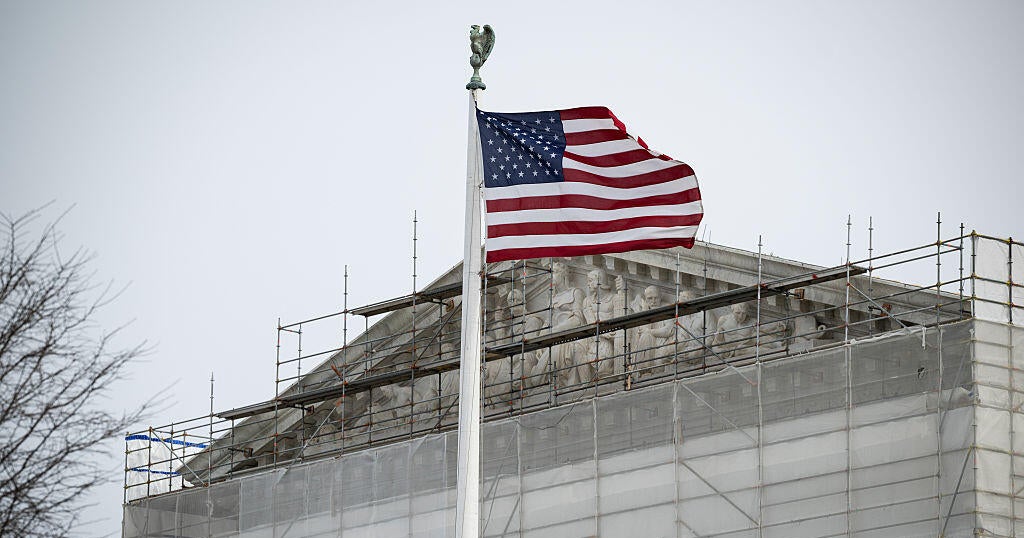
Washington — The Supreme Court on Tuesday grappled with the legality of federal limits on the amount of money a political committee can spend in coordination with a federal candidate, hearing a case that could join a line of recent fights that have led the high court to dismantle campaign finance restrictions.
The dispute, known as NRSC v. FEC, involves caps imposed by Congress on what are called coordinated party expenditures through the Federal Election Campaign Act of 1971, which was passed to regulate the financing of federal campaigns.
For the 2023 to 2024 election cycle, party committees could spend between $61,800 to $123,000 for House seats and between $123,600 to $3.7 million for Senate seats, according to the FEC. Congress amended the law in 2014 to allow unlimited coordinated spending on certain activities, such as election-recount lawsuits and other legal proceedings.
The legal battle before the high court was brought in 2022 by then-Senate candidate JD Vance, then-Rep. Steve Chabot of Ohio and two GOP committees, the National Republican Senatorial Committee and the National Republican Congressional Committee.
The Republicans sued the FEC and argued that the coordinated spending limits violate the First Amendment’s Free Speech Clause. A federal appeals court upheld the caps, citing a 2001 Supreme Court ruling that had left them in place.
The Republicans appealed to the Supreme Court. The FEC under President Trump agrees that the spending limits burden the rights of political parties and candidates and should be struck down. The high court appointed a lawyer, Roman Martinez, to argue in defense of the restrictions, and allowed a trio of Democratic Party committees to intervene.
Oral arguments
Over the course of the arguments on Tuesday, three of the court’s conservative justices, Clarence Thomas, Samuel Alito and Brett Kavanaugh, appeared likely to strike down the spending caps as a violation of the First Amendment.
Kavanaugh repeatedly expressed concern about the power of political parties and whether they have been weakened relative to outside groups like super PACs because of campaign finance laws and the Supreme Court’s decisions. That weakening has
Supreme Court weighs campaign finance limits in GOP-backed challenge