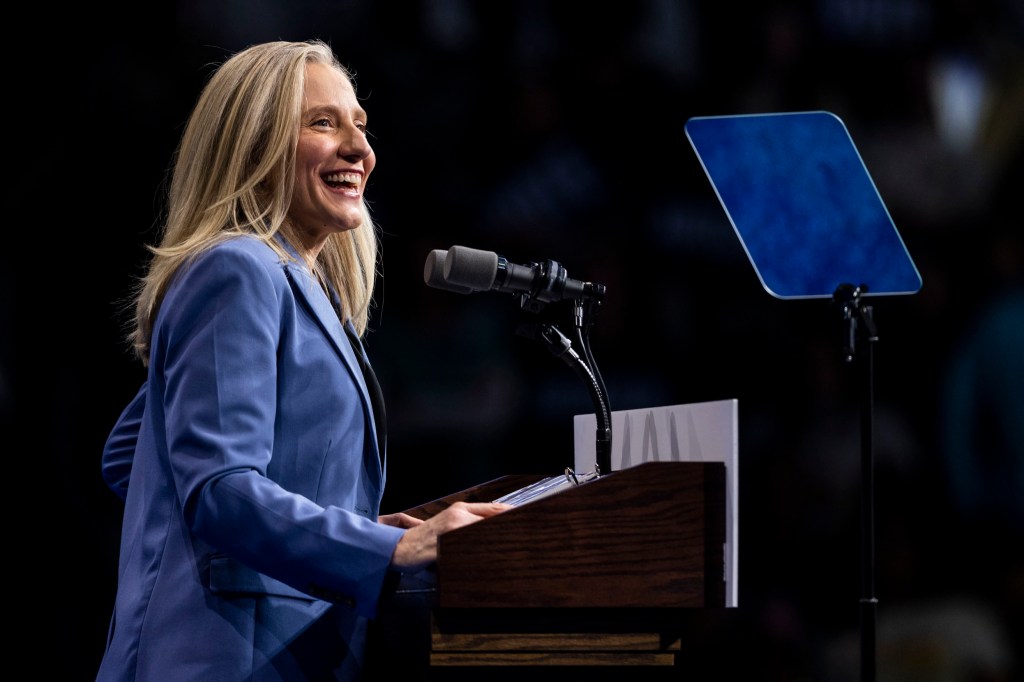
Gov.-elect Abigail Spanberger promised the state’s top business organization on Friday that she’ll be working right from the start to boost investment in the state.
And roughly a year after her opponent in the 2025 election, Lt. Gov. Winsome Earle-Sears, told the same group Virginia’s right-to-work law was at risk if Spanberger were elected, Spanberger offered reassurance.
“I intend to make sure there is stability and certainty across our business environment. That is why I was clear on the campaign trail I will not sign a bill that repeals Virginia’s right-to-work law,” she told the several hundred business leaders at the Virginia Chamber of Commerce’s unveiling of its latest “Blueprint Virginia” recommendation for policy actions.
That won her a standing ovation.
Virginia’s right-to-work law says workers can’t be required to join a union as a condition of employment, even if they would benefit from union wages and job protections.
Spanberger said key areas in the chamber’s blueprint matched her agenda, including investing in K-12 and higher education, boosting access to child care and tackling the affordable housing challenge.
She also talked about more traditional business concerns.
“When it comes to energy costs, my administration will make reliable, affordable and resilient energy generation a top priority,” she said.
She said she wants to ensure that Virginia keeps bringing new businesses to Virginia and helping businesses here expand.
“We can do this by investing more in developing shovel-ready sites across Virginia,” she said.
She said she wants to see more career and technical education opportunities in Virginia schools.
“We must also invest in our people through a coordinated workforce training and development program, one that starts early in our educational system,” she said.
Spanberger said she’ll focus on helping the state’s Main Street communities — the often-struggling centers of the state’s smaller cities and towns — and on bringing investment and jobs to the enterprise zones meant to woo development in historically distressed communities.
“We will retool, reinvent,” she said.
“I am committed to finding ways to increase the amount of public and private capital resources that are available to entrepreneurs. We need to incentivize those with a good idea to build tomorrow’s world-class companies here,” she said.
But she added: “These investments will fail to meet the moment if we fail to tell a Virginia story adequately. That is why we must invest in marketing to both business executives and workers so that they know that Virginia is open for business … that Virginia is the place they want you to go for a career.”
She said the 250th anniversary of American independence next year will be a chance to show off the state.
“We need to recognize (that) visitors from across the country, around the world, will be coming to Virginia,” she said.
Virginia faces economic challenges, as federal workers and contractors lose their jobs, and President Donald Trump’s taxes on imports cut business at the Port of Virginia and spark retaliation that’s hitting Virginia farmers and the forestry sector.
Spanberger said she wants to work with the federal government on national defense, energy and securing a leading position in artificial intelligence developments.
“My goal is to hit the ground running with executive orders targeted at the challenges we face and also to deliver the best strategic plan early so that we can aggressively pursue what it takes to succeed,” she said.
Spanberger plans to ‘hit the ground running’ to boost Virginia’s economy. Here’s how.