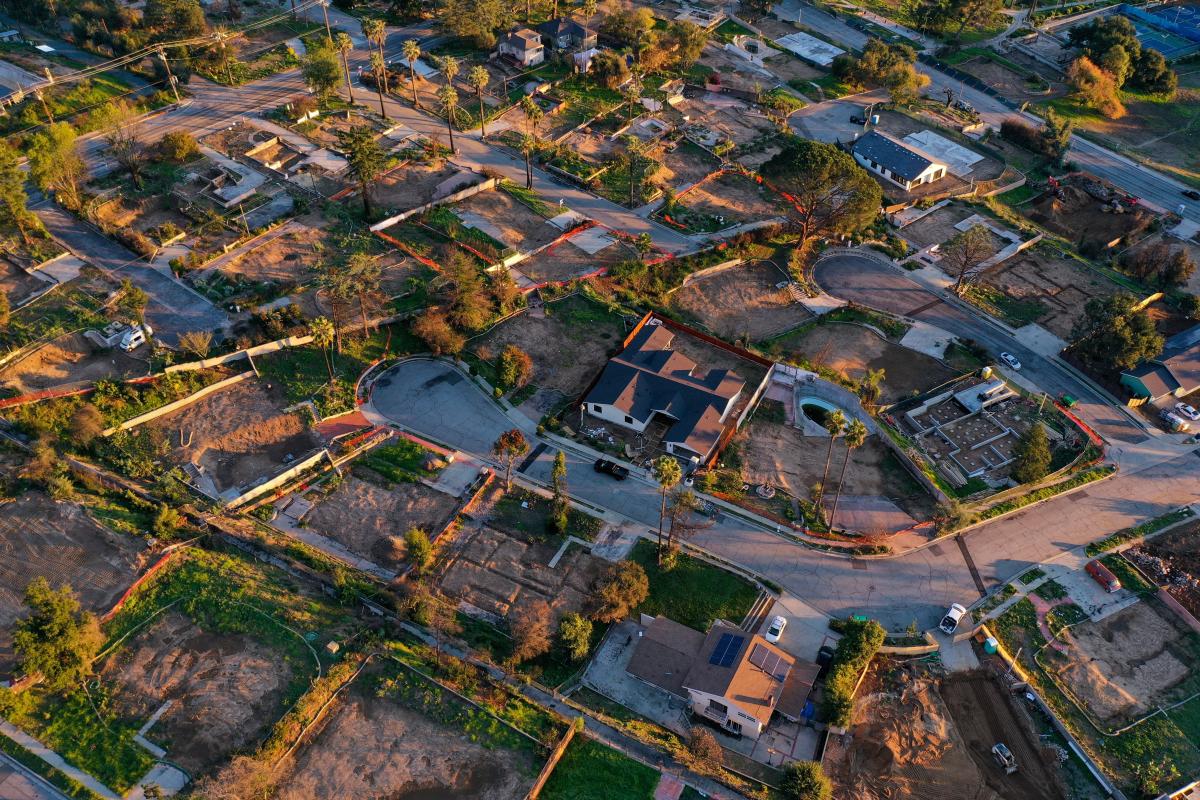
We Californians lost our homes in the Eaton and Palisades fires last year. In the aftermath, we lost the naive belief that insurance would work the way we were promised.
We knew rebuilding would be hard, but we believed we were protected.
We had paid insurance premiums for decades. We assumed that when disaster struck, insurance would be there.
We never imagined delays and denials would become one of the biggest barriers to recovery.
Insurance was supposed to be our safety net. Instead, it became a wrecking ball.
California has some of the strongest consumer protections in the country against insurance delays and denials.
Yet today, 70% of insured Eaton and Palisades survivors report that insurance delays or denials are actively blocking their recovery.
The consequences have been devastating: Survivors have drained retirement accounts, maxed out credit cards and watched the futures they worked so hard to build for their children slip away.
Local mental-health providers report rising suicidal ideation tied directly to extreme financial and housing insecurity.
Insurance companies are able to operate this way because most survivors are isolated.
Each family assumes their struggle is unique. Exhaustion sets in.
People stop pushing because they simply have nothing left to give.
That is where our story could have ended. What changed everything was connection.
When the Eaton Fire started, I happened to be the administrator of a local pickleball chat in Altadena.
Within minutes, that chat became our evacuation network. Soon after, it became the Eaton Fire Survivors Network, where survivors organized into recovery channels, including separate channels for each insurance company.
Within weeks, a disturbing truth emerged. Whether a family was recovering depended largely on one factor: which insurance company they had.
For families insured by the worst-performing companies, the trauma compounded each day.
In April, we held a 100-day anniversary press conference calling on State Farm — the biggest private insurer in the area — to do better, not just for Eaton families but for Palisades survivors as well.
That same day, State Farm raised its standard payout for lost contents from 50% to 65% of estimated losses for Eaton and Palisades survivors only.
(To receive 100%, one has to itemize each and every item that was lost — a daunting task.)
With families hanging on by a thread, that change meant millions of dollars finally reaching households that had been waiting for months
I was invited onto the Palisades podcast “Three Homeless Guys,” which brought Eaton and Palisades survivors into contact.
Survivors began working together to document what insurance companies were doing — or not doing.
Nearly 500 survivors shared detailed accounts of delays, denials, rotating adjusters and underpayments.
We mapped those experiences directly to violations of California law in what became known as The State Farm Files.
We brought this evidence to state leadership. Survivors wrote more than 1,500 postcards to Insurance Commissioner Ricardo Lara and Gov. Gavin Newsom, sharing our stories and laying out specific actions they could take immediately to end illegal delays and denials.
Little changed. So we kept going.
We brought all the evidence we had amassed to Los Angeles County leaders, who immediately opened a formal investigation into State Farm’s handling of Eaton and Palisades fire claims.
Within hours, survivors who had been stuck for months began receiving phone calls.
Construction cost estimates that had been unrealistically low were suddenly revised. Six- and seven-figure insurance payments that had been held up for months arrived by FedEx.
Nothing else had changed. The facts were the same. What changed was accountability.
Survivor coordination has helped unlock millions of dollars and steer them directly into families’ pockets, with millions more now moving through reopened claims and revised settlements.
Not because insurers suddenly became generous, but because survivors made enforcement finally happen.
At a time of rising disasters nationwide, here’s what we’ve learned: After disaster, connection matters. Connection creates coordination. Coordination moves money. And money makes recovery possible.
One year in, we’ve reached important milestones. But we are just getting started.
Year 1 was about survival and learning how recovery really works. It was about connecting across fires, comparing experiences and holding institutions accountable for their promises.
Because we did, money began to move.
As we enter Year 2, we do so on stronger footing than we had on that terrifying day we watched our homes burn. We now have shared knowledge, shared data and shared relationships.
Year 2 is about expanding our coalition of fire survivors to hold all insurers accountable. Because without the billions they still owe, recovery will not be possible.
This is no longer a story about one fire or one community. It is a test of whether the systems Americans rely on after a disaster will work at all.
If you pay insurance premiums and expect the benefits you paid for when disaster strikes, this fight belongs to you, too.
Joy Chen is executive director of the Eaton Fire Survivors Network and a former deputy mayor of Los Angeles.
We fought our insurers after the California fires by uniting – and won