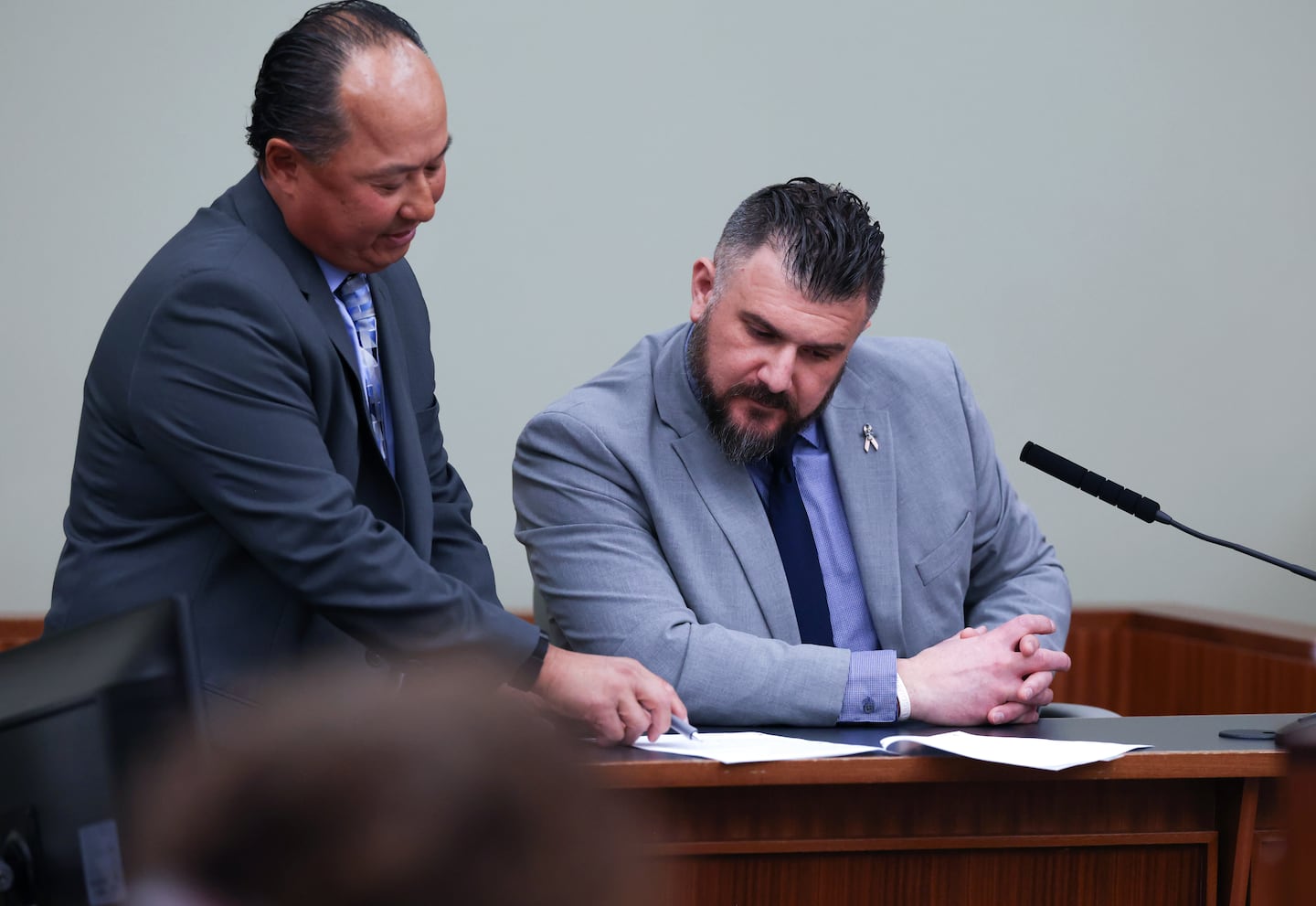
Naso’s wife, Shahrzad Naso, known as Sherry, died from metastasized breast cancer in April 2024. Three months after her death, her parents, Dr. Siavash Ghoreishi, a pediatrician, and Dr. Jila Khorsand, a pathologist, went to Family Court to force Naso to allow them visits with Laila, their only grandchild.
After his wife died, Naso told Gill, he discovered things about his in-laws’ actions and medical care of his wife and daughter that raised alarms. And, during the litigation, Naso said he has uncovered more that’s convinced him they should never be around his daughter.
As Naso took the stand on Thursday in the 14th day of the grandparents visitation rights trial, Gill asked him to explain his reasons to refuse visits.
Naso has testified about a toxic relationship with his in-laws and interference in his marriage to their daughter and his parenting of Laila. He testified that Ghoreishi prescribed dozens of medications to Sherry Naso and Laila, and that both of Sherry Naso’s parents told her that her stroke-like symptoms were caused by Prozac withdrawal and lymphedema, when she actually had a massive brain tumor.
He has testified about how Sherry Naso trusted and relied on her parents, to the point of straining her own marriage and ignoring advice from her psychiatric nurse practitioner, and that he believes their medical care and advice led to her death.
Naso, who is a narcotics detective in Middletown, told the judge Thursday that he reviewed medical and insurance records and found that his father-in-law had filed dozens of claims to Blue Cross for him, Sherry Naso, and Laila.
Ghoreishi was Laila’s pediatrician and testified that he treated Sherry Naso. He previously testified that he did not believe he was being unethical. He also said that he treated Naso at his pediatric practice.
Naso testified that he had never been Ghoreishi’s patient, but he found that his father-in-law made 27 claims for treating him. Naso called them fraudulent.
“Some of the claims I wasn’t even here,” Naso told the judge. “There was a claim made when Sherry and I were at a wedding out of state.”
There were dozens more for Sherry Naso and Laila, Naso said.
Lawyer Michael Ahn, who is representing the grandparents, tried to strike Naso’s testimony about prescription drugs and insurance billing. The judge brushed him off.
“No, it won’t be stricken,” the judge said to Ahn, then turned to Naso.
“You think he [Ghoreishi] perpetuated a fraud? That’s why you’re denying visitation?” Gill asked.
“I think it goes to judgment,” Naso said.
“So, that’s a yes,” Gill said.
The American Medical Association Code of Medical Ethics and the Rhode Island Department of Health advises physicians against treating themselves or immediate family members, out of concern that those relationships can compromise professional objectivity and medical judgment.
For that reason, the Blue Cross & Blue Shield of Rhode Island’s policy does not cover a physician’s services to a family member.
The judge zeroed in when Naso testified about finding prescription bottles for Xanax, a controlled substance, in his home after Sherry Naso died.
Naso said that Ghoreishi had prescribed the pills for Khorsand and the office manager at his pediatrics practice in East Greenwich.
Under state law, physicians are forbidden from prescribing controlled substances to themselves or immediate family members.
Ghoreishi has previously testified that he prescribed Dexedrine, another controlled substance, to his daughter “20 or 25 years ago” when she was between neurologists and needed her prescription.
Naso told the judge Thursday that he believed the Xanax prescriptions were actually intended for Sherry Naso. He said that Khorsand’s prescription bottle disappeared while her sister-in-law was staying at his home during Sherry Naso’s funeral. He said she was rummaging through the cabinets.
Gill, a former chief of the attorney general’s narcotics and organized crime unit, was immediately interested. “When did you report this to the police?” he asked.
Naso said he went on July 2, 2024, to the Portsmouth Police Department and told them about finding the Xanax pills, his suspicions over his wife’s death, and seeing his in-laws force prednisone down his daughter’s throat without his permission.
“I assumed the Portsmouth police would do an investigation,” Naso said. He told the judge that the police didn’t take his statement or accept the prescription bottles that he found.
Naso said he went to the state police and attorney general’s office that October.
“Did you tell them about the missing pills?” Gill asked.
“I remember telling them I had concerns that [Ghoreishi] was prescribing to his wife, and I had concerns that he was prescribing and converting [the medication],” Naso answered.
Ghoreishi closed his pediatric practice the day Sherry Naso died, and both he and Khorsand let their state medical licenses expire in 2024.
Naso filed a complaint against them anyway at the state Board of Medical Licensure and Discipline in January 2025. The investigation is still pending.
Naso’s manner was matter-of-fact as he described the narcotics investigation he conducted into his own family and what he has uncovered.
When asked about his wife’s last days in the hospital after brain surgery left her in a coma, Naso broke down on the stand.
Naso told the judge what happened when he called Sherry Naso’s parents to tell them she was dying and they need to visit her soon. “They responded, ‘I think we’ll pass,’” Naso said.
“Why is that significant to you?” Gill asked.
“They never came to the hospital for 11 days, that’s significant to me,” Naso said. “’I think we’ll pass’ — how do you not see your only child on her deathbed? … It was like Sherry was nothing. She’s 37 years old, she’s your daughter, your only child.
Questions about alleged insurance fraud and prescriptions surface in R.I. grandparents rights trial