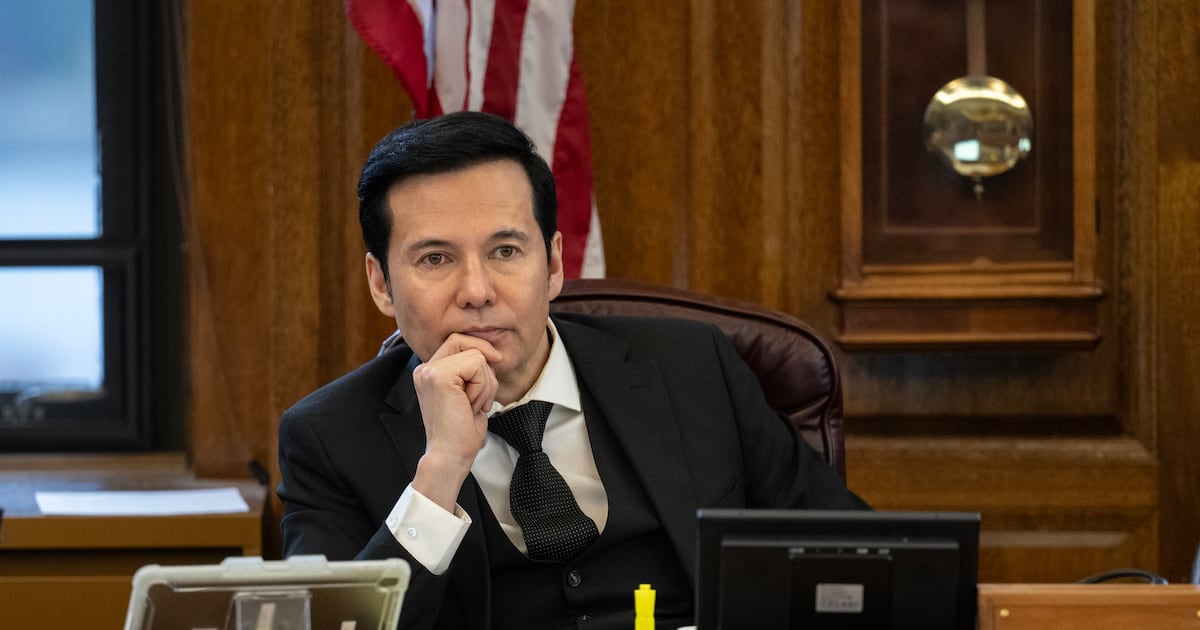
The Alaska House Finance Committee on Wednesday at 11 p.m. approved its draft of the operating budget, complete with a controversial dividend proposal, concluding 12 hours of debate spread over two days.
The 11-member committee voted 6-5 to approve a spending plan that would — if fully approved by the House and Senate — drain roughly half of the state’s rainy day fund to send every eligible Alaskan a statutory Permanent Fund dividend payment of around $3,800.
Two out of the three House Finance co-chairs voted against setting the Permanent Fund dividend according to an existing statute that has not been followed since 2016, instead favoring a smaller dividend of roughly $1,000 per eligible Alaskan.
But the third House Finance co-chair, Nome Democratic Rep. Neal Foster, joined the committee’s five minority Republicans to pass a dividend plan that would spend $2.4 billion in state funds on the annual payments, including $1.4 billion drawn from the Constitutional Budget Reserve.
Foster said the payments are needed as rural Alaskans contend with higher costs, including for ever-more expensive heating fuel. But the payments are far from assured.
The dividend plan, proposed by Ketchikan Republican Rep. Jeremy Bynum, would assure Alaskans a dividend of around $1,500. The remaining portion of the statutory $3,800 dividend would be paid only if lawmakers succeed in accessing the Constitutional Budget Reserve account, which requires support from three-quarters of members in the House and Senate.
[Murkowski calls on Alaska lawmakers to adopt a ‘legitimate fiscal plan’]
That appears unlikely, according to Anchorage Democratic Rep. Andy Josephson, who led the operating budget drafting process in the Finance Committee. Josephson said most members of the House majority favor a more modest dividend, which would leave lawmakers more room to increase spending on school operations and maintenance, among other state services.
“A $1,500 dividend makes it very, very hard to do other things in the budget, and I mean most of the things,” Josephson said Tuesday, as lawmakers launched into marathon debates on 113 budget amendments.
Josephson unsuccessfully attempted to set the dividend at $1,000 per recipient — equal in size to last year’s payout. Rep. Calvin Schrage, an Anchorage independent who co-chairs the committee, joined Josephson in speaking in favor of that figure.
“I know that it is insufficient in some folks’ minds, but I think whatever amount we ultimately pursue, it needs to fit within the bounds of the revenue that we have, the expense expectations that we have, and the public’s demands for us to balance all of these various needs,” Schrage said.
But Foster argued that the state could, in theory, afford a statutory dividend if the Legislature increased its taxation of oil production in Alaska. Some lawmakers are pushing for higher oil taxes, but they are unlikely to be approved this year.
“I just don’t know how many Alaskan families are going to get by. Alaskans need help, and what better way to provide that help than to give Alaskans their share of Alaska’s resource wealth via the Permanent Fund dividend,” Foster said.
The debate on the size of the annual dividend to Alaskans has regularly transcended party lines and caucuses. Many Republicans — including Gov. Mike Dunleavy — say they want to follow the existing statute on the books for the annual payout. They are joined by some Democrats who represent districts with large shares of low-income constituents.
But lawmakers have so far not been able to agree on a plan for increasing state revenue sufficiently to afford following the existing dividend formula.
Even if the Legislature removed all funding for courts, prisons, jails, troopers and prosecutors, the state still would not have enough projected income next year to pay a statutory dividend without drawing from its already depleted savings account.
Bynum’s plan, rather than cutting funding for all public safety across the state, instead calls for drawing $1.4 billion from the Constitutional Budget Reserve, nearly half the amount currently in the account.
Bynum said his proposal “provides a compromise position that offers that statutory Permanent Fund dividend while providing a funding source.”
Earlier in the debate process, Bynum, along with Fairbanks Republican Rep. Will Stapp, voted against a proposal from Foster to pay a statutory dividend without directing lawmakers to draw from the Constitutional Budget Reserve.
Bynum proposed the draw from savings after members of his caucus last month vehemently opposed a draw from the same account to pay for expenses in the current fiscal year, including transportation projects and disaster response.
Schrage said the plan approved by the committee sets up a “false expectation” and is “fairly disingenuous,” because the likelihood of reaching the three-quarters threshold to fund a statutory dividend is low.
“I don’t think the votes are there, and so it puts a full PFD into the budget in concept, but the votes would not be there to fund it, and so it would give people false hope just for the rug to be pulled out from under them,” said Schrage.
Those in favor of the plan included Bynum; Foster; Rep. Jamie Allard, R-Eagle River; Rep. Frank Tomaszewski, R-Fairbanks; and Rep. Elexie Moore, R-Wasilla.
Those opposed included Schrage; Josephson; Rep. Alyse Galvin, I-Anchorage; Rep. Sara Hannan, D-Juneau; and Rep. Nellie Jimmie, D-Toksook Bay.
Jimmie, who like Foster represents a district made up of many predominantly Alaska Native villages that rely on the dividend to cover basics like heating fuel, castigated other committee members for promoting a plan that would ultimately leave the dividend program without a sustainable future.
“I’m here today, and I’m thinking seven generations ahead. I’ve said it once, and I’ll say it again. If we gave out a full Permanent Fund (dividend) for the past eight years, there would be no PFD right now. My grandkids won’t get it,” she said. “Unless we’re all willing to bring in new revenue to the state of Alaska, we need to stop fooling around with this full PFD. I believe I should get a full PFD, but I’m being realistic. I grew up poor, with limited income. I know what it’s like to fight for every dollar you get. So stop playing around with this kind of politics.”
The spending plan advanced by the Finance Committee also includes a $158 million increase to annual state spending on K-12 schools. Lawmakers are still at work crafting a separate capital budget to cover the cost of infrastructure projects, which is expected to include a funding boost for school construction and maintenance.
House Finance members adopted several other amendments to the operating budget, including to restore a long-dormant heating assistance program that could send low-income Alaskans roughly $17 million annually to help defray the cost of fuel; to increase spending on early intervention and infant learning programs by $5.7 million; to increase spending on community jails by $5 million; and to add building management specialist in the state education department at a cost of $430,000.
Lawmakers agreed to cut $450,000 from the education department for a student information dashboard that was intended to provide information on reading proficiency; $350,000 intended for a media campaign to recruit more foster parents; and $250,000 intended for the state transportation department to abate homeless encampments on state-owned land.
Alaska House budgeters advance statutory dividend, contingent on savings draw