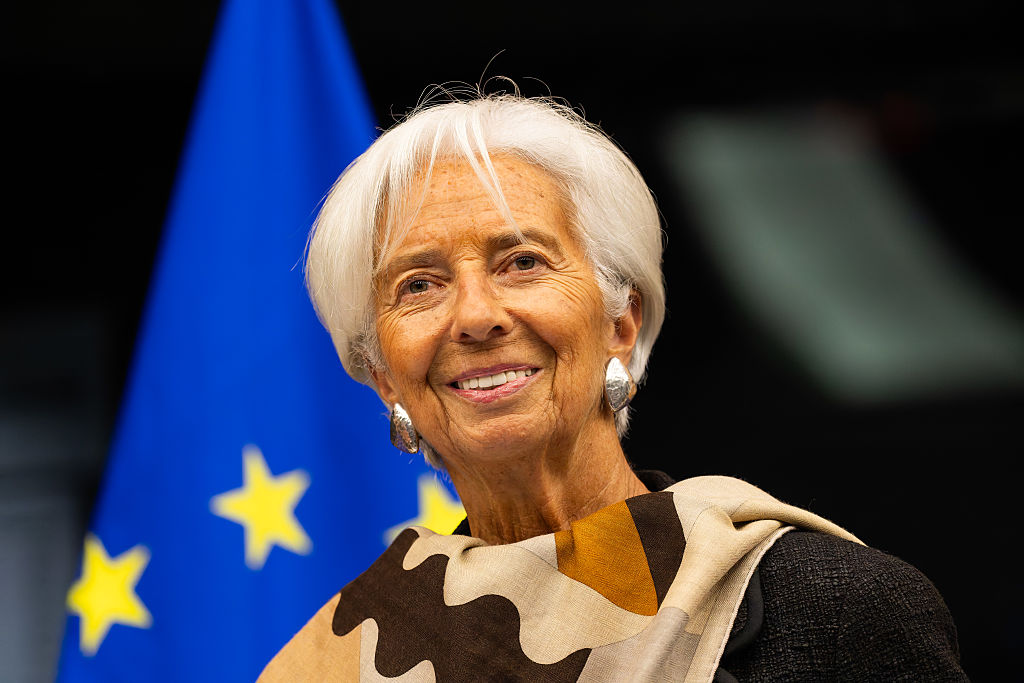
The European Commission’s latest proposal to use immobilised Russian sovereign assets to finance Ukraine comes the nearest so far to complying with international law, European Central Bank President Christine Lagarde said on Wednesday.
The scheme, formally presented to European capitals last week, seeks to harness up to €210 billion in Russian assets held in the EU. Lagarde said it should also reassure investors who fear that the so-called “reparations loan” amounts to confiscation.
The ECB has repeatedly warned that any illegal use of the assets could spark capital flight from the eurozone and potentially undermine the bloc’s financial stability. Similar concerns have been expressed by Belgium and Euroclear, the Brussels-based securities depository that holds the vast majority of the assets earmarked for the loan.
“I believe that the scheme … is the closest I have seen to something that is in compliance with the international law principles,” Lagarde said at a Financial Times event.
She added that it is “critical” that the Commission’s legal proposal “does not remove the title of Russia to the assets.”
“I believe that investors in euro-denominated assets and in Europe will appreciate” that the EU does not seek to “remove sovereign assets because it suits us,” Lagarde said. “It’s a very, very exceptional case.”
The Commission’s legal argument relies on the fact that the assets have largely matured into cash since being immobilised following Russia’s full-scale invasion of Ukraine in 2022.
Since EU sanctions prevent the return of the cash balances to Moscow, the money is no longer the Kremlin’s property, the Commission argues. Rather, it contends that Moscow’s “asset” is the “claim” it has on EU financial institutions housing the funds, including Euroclear.
“That claim of the Russian Central Bank is Russia’s asset,” the Commission’s legal proposal states, adding that the “cash balances are not the property of the Central Bank of Russia and are not protected by sovereign immunity.”
Belgian bargaining
Lagarde’s comments come ahead of a crunch European Council meeting next week, where EU leaders are aiming to persuade Belgian Prime Minister Bart De Wever to drop his staunch opposition to the scheme.
De Wever – who has condemned the loan as “fundamentally wrong”– has refused to back the proposal unless its legal and financial risks are shared, and other countries also commit to using Russian assets held in their own jurisdictions.
Over the past week, Belgium has proposed significant amendments to the Commission’s legal proposal, according to EU officials. These include a demand that other EU countries provide unlimited financial guarantees in case the Kremlin successfully sues Belgium for damages exceeding the total value of the loan.
France, believed to hold up to €19 billion in Russian sovereign assets, is also reluctant to use Russian funds held in its own private banks, as demanded by the Commission and De Wever, the officials say.
De Wever continues to push EU states to issue joint debt instead to support Kyiv, which is expected to run out of money in April next year. However, Hungary – whose pro-Moscow leader Viktor Orbán has refused to provide any additional funding to Kyiv – is blocking this option.
The Commission proposes to cover just two-thirds, or €90 billion, of Kyiv’s funding needs for 2026 and 2027. But it also said it is prepared to eventually use all of the €210 billion in Russian assets frozen by the EU after the full-scale invasion.
Asked to comment on the Commission’s proposal, Euroclear said: “We continue to stress the importance that any action or agreement avoids undermining confidence in international financial markets by safeguarding the legal order and legal certainty which underpin global economies.”
A Belgian government spokesperson declined to comment.
EU envoys are expected to discuss the scheme further this afternoon.
(vib, aw)
EU’s new Ukraine loan scheme ‘closest’ to being legal, says Lagarde