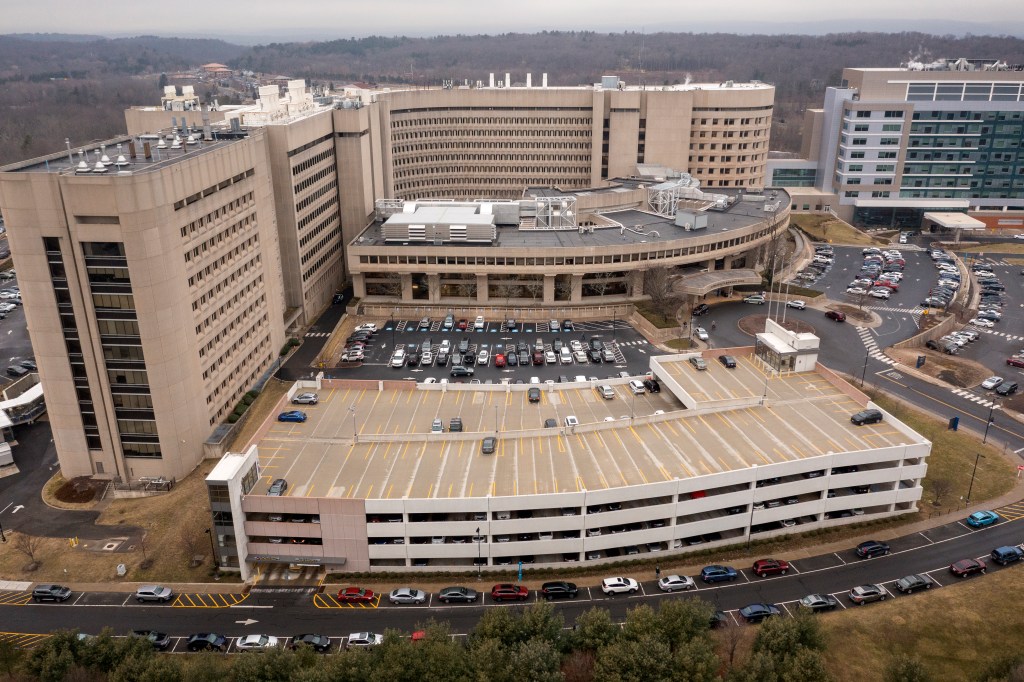
On Sunday, March 1, Waterbury Hospital becomes the first of three hospitals expected to join UConn Health in the newly created $400 million UConn Health Community Network.
The new entity, intended to rescue three financially distressed hospitals, will be led by UConn Health CEO Dr. Andrew Agwunobi.
He is the wrong person for the monumental job ahead.
Agwunobi is on his second tour of duty in charge of UConn Health. His first eventful tenure was from 2014 to 2022. He left for Humana’s Home Solutions in 2022 and returned to UConn Health in 2024 after one of those UConn nationwide searches that often end with someone the university’s leaders already know.
The personable Agwunobi also served as UConn’s interim president before UConn faculty member Radenka Maric won the top spot in 2022.
In the fullness of time, Agwunobi’s eight years at the helm of UConn Health were a disappointment and a cautionary tale that makes him ill-suited to run a new hospital system that will be much bigger and far-flung than the one he ran for eight years.
Agwunobi was CEO when Pierluigi Bigazzi, a UConn Health professor, was killed by his wife in their Burlington home in July 2017. Professor Bigazzi continued to be paid by UConn until his body was discovered in 2018. The scandal caused a searing public spotlight to be cast on UConn Health’s financial management practices. More would follow.
In May 2018, the Connecticut state auditors released a report that raised serious concerns about Agwunobi’s disregard of basic conflict of interest tenets. It found that when Agwunobi came to UConn Health in 2014 he remained an employee of Berkeley Research Group, which at the time had a consulting contract with UConn Health.
The auditors found that the two UConn Health employees who approved payments to Berkeley Research Group received salary increases, approved by Agwunobi. The auditors also discovered that Agwunobi was in charge of preparing a performance review and evaluation for one of those two employees. Agwunobi’s role, the auditors noted, and he should have known, created an atmosphere in which they felt they had little choice but to ask few questions about Berkeley Research’s work and invoices.
Then there was the misbegotten, no-bid $140 million contract for medical services between the state Department of Corrections and UConn Health. It is fair to say after reviews and litigation, that UConn Health allegedly mistreated and ignored inmate health complaints. The state contract with UConn was canceled in 2018 after reports of missing medical records and failure to meet basic care standards emerged.
Agwunobi has created stirs in private sector positions. He served as a member of the board of WellCare Health Plans for eight months in 2006. He left at the end of 2006 and cashed in $1 million in stock awards that had vested after only a short time on the board, an unusual arrangement for such a short tenure. It is one that others in the company did not receive, to their considerable cost. Agwunobi went from the WellCare board to lead the Florida agency that oversaw the state’s Medicaid program, services that included WellCare as a provider.
Agwunobi’s tenure on WellCare’s board is not included in his extensive profile page on the UConn Health website.
Agwunobi left the Florida agency regulating Medicaid 14 months later.
During his two and a half years as president and CEO of Georgia’s Grady Health System, from 2003 to early 2006, Agwunobi claimed to have wrestled the healthcare network’s finance into better health than when he arrived. Three years after Agwunobi left Grady, his successor announced the hospital was required to pay $20 million to the state for overpayments because Grady “aggressively maximized” Medicaid billing to the state during the Agwunobi years, according to HealthLeadersMedia.com.
Agwunobi had claimed to have shaved $20 million off the hospital’s debt. In 2007, the historic hospital caught the nation’s attention when it revealed it was running out of money. National Public Radio reported that Grady, “Atlanta’s only safety net hospital for the poor…is on the verge of collapse.” By then, Agwunobi was settled 3,000 miles away in sunny California at the head of a Catholic healthcare system.
This information is available by conducting some internet searches. UConn trustees and UConn Health directors must have become aware of Agwunobi’s previous jobs. They also know he was sued by a former UConn Health employee for retaliation after she was fired allegedly for rooting out an employee who’d made fraudulent overtime claims and investigated astonishing allegations of sexual harassment against a UConn health faculty member.
In response to questions about Agwunobi’s previous jobs, UConn Health spokesperson Jennifer Walker, wrote, in part, on Friday, “This unfortunately appears to be a deliberate effort to damage Dr. Agwunobi’s reputation at a celebratory moment for UConn Health, which is days away from launching the UConn Health Community Network, a first-of-its-kind partnership designed to strengthen and sustain community hospitals across the state… Dr. Agwunobi is a widely respected, award-winning, values-driven health care executive with a long, proven record of stabilizing and transforming hospitals in multiple states.”
Agwunobi’s base salary at UConn Health is $800,000 a year, and his background is public information. That it is making its way into public view is due to the misplaced authority he will exercise in a plan to force Connecticut residents, particularly state employees and retirees, to use failing hospitals propped up under the cover of UConn Health. A hospital that has been a drain on the state’s finances for decades.
Reach Kevin F. Rennie at kfrennie@yahoo.com
Kevin Rennie: The wrong person for a CT job at the wrong time