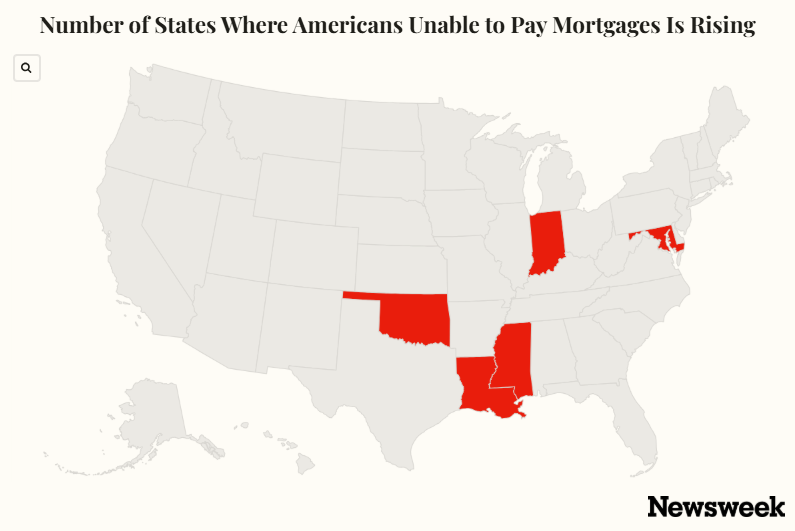
The number of Americans unable to pay mortgages is rising, and certain states and regions face higher risk than others.
While the national mortgage delinquency rate remains far below the crisis levels of the Great Recession and unemployment is nowhere near double digits, the ability to pay a mortgage increasingly depends on where a homeowner lives, how much they earn and what kind of loan they have.
New data from the Mortgage Bankers Association shows the largest quarterly increases in their overall delinquency rate were in Mississippi, Louisiana, Maryland, Oklahoma and Indiana.
Why It Matters
Mortgage delinquency can indicate larger economic strife, as inflationary pressures and job losses mount, but specific numbers typically reveal geographic and income-based divides, especially among Southern states.
What To Know
Mississippi, Louisiana, Maryland, Oklahoma and Indiana all experienced an increase of 86 basis points or more in overall delinquency rates during the fourth quarter of 2025.
By the end of 2025, the share of U.S. mortgage borrowers who were at least one payment behind had risen to 4.26 percent, according to the Mortgage Bankers Association’s National Delinquency Survey. That marked a clear increase from both the prior quarter and the year before, with delinquencies rising across conventional, FHA and VA loans alike.
“Mortgage delinquencies are rising fastest in the poorest states with the weakest economies and the most FHA loans,” Michael Ryan, finance expert and founder of MichaelRyanMoney.com, told Newsweek.
“This isn’t a national crisis, yet. It’s a regional one that’s being ignored because it’s not hitting wealthy coastal metros. But foreclosures don’t stay contained. They depress home values, tighten credit, and force people into rental markets that can’t absorb them. What starts in Louisiana doesn’t stay in Louisiana.”
Data from the Federal Reserve Bank of New York also showed that mortgage delinquencies were climbing fastest among borrowers in lower-income communities, even as higher-income homeowners remain largely insulated.
In ZIP codes with the lowest incomes, the share of mortgages that are at least 90 days past due has surged since 2021, rising from roughly half a percent to nearly 3 percent by late 2025. In the highest-income areas, delinquency rates have stayed comparatively low and stable.
States Most at Risk
The steepest increases in mortgage delinquency were concentrated in the South and parts of the Midwest, according to both industry and Federal Reserve data. Louisiana and Mississippi repeatedly appear at or near the top of state rankings, with delinquency rates that far exceed the national average.
In coastal Southern states like Florida, Georgia and South Carolina, rising serious delinquencies have coincided with sharp increases in insurance premiums and property taxes.
While the South and Midwest lag, the West Coast has stayed relatively isolated, Ryan said, with California, Oregon and Washington at under 2 percent delinquency.
“The K-shaped housing recovery isn’t theoretical anymore. It’s showing up in the data as clear geographic winners and losers,” Ryan said.
At the national level, the Federal Reserve’s own banking data shows the delinquency rate on single-family residential mortgages held by commercial banks rising to 1.78 percent in the third quarter of 2025, a level that remains historically modest but is trending upward after years of decline.
According to the New York Fed, counties that experienced the largest increases in unemployment over the past year also saw mortgage delinquencies worsen more sharply than areas where job markets remained stable. In places where unemployment rose the fastest, mortgage delinquency rates increased by nearly 0.6 percentage points, compared with roughly 0.2 percentage points in counties with steadier employment.
“These are Trump states dealing with a housing crisis that’s getting worse, not better,” Ryan said. “That creates real political risk.”
What People Are Saying
Alex Beene, financial literacy instructor for the University of Tennessee at Martin, to Newsweek: “When Americans hear mortgage delinquencies are on the rise, they undoubtedly get flashbacks to the housing crisis that was one of several factors that triggered the Great Recession. However, it’s important to understand the scale of the problem. While mortgage delinquencies are on the rise, they are still far away from the highs we reached two decades ago.”
Ryan, also to Newsweek: “Long-term implications start with a foreclosure wave in FHA hotspots. Repos could hit 2008 levels locally, depressing home values and tightening credit further for lower-income buyers. Rental market spillover comes next. Displaced homeowners flood rentals, driving up prices in already tight Sun Belt and Rust Belt metros. That pushes more people into financial instability and creates a feedback loop.”
What Happens Next
While Americans may want to sound the alarm based on regional upticks, Beene said the jumps in delinquencies do not necessarily indicate recession concerns.
Map Shows US Regions Where More Homeowners Struggling to Pay Mortgages